

You do not need thousands of pounds to build a LEGO City.
A realistic beginner budget of £250–£500 is enough to create a small but impressive layout with a few buildings, roads, vehicles and minifigures. From there, you can expand at whatever pace suits your budget.
The biggest factor isn’t how much money you spend—it’s how well you plan your purchases.
Why Is There Such a Big Price Range?
Unlike a normal LEGO set, a LEGO City isn’t one purchase.
It’s an ongoing project that grows over time.
Some people build a small street on a bookshelf.
Others spend decades creating exhibition-sized cities with trains, lighting, docks, airports and hundreds of buildings.
Neither approach is more “correct”.
The best LEGO City is simply the one that matches your available space, budget and interests.
What Does a LEGO City Actually Cost?
Rather than asking:
“How much does a LEGO City cost?”
A better question is:
“How much LEGO City can I build with my budget?”
Here’s what different budgets can realistically achieve.
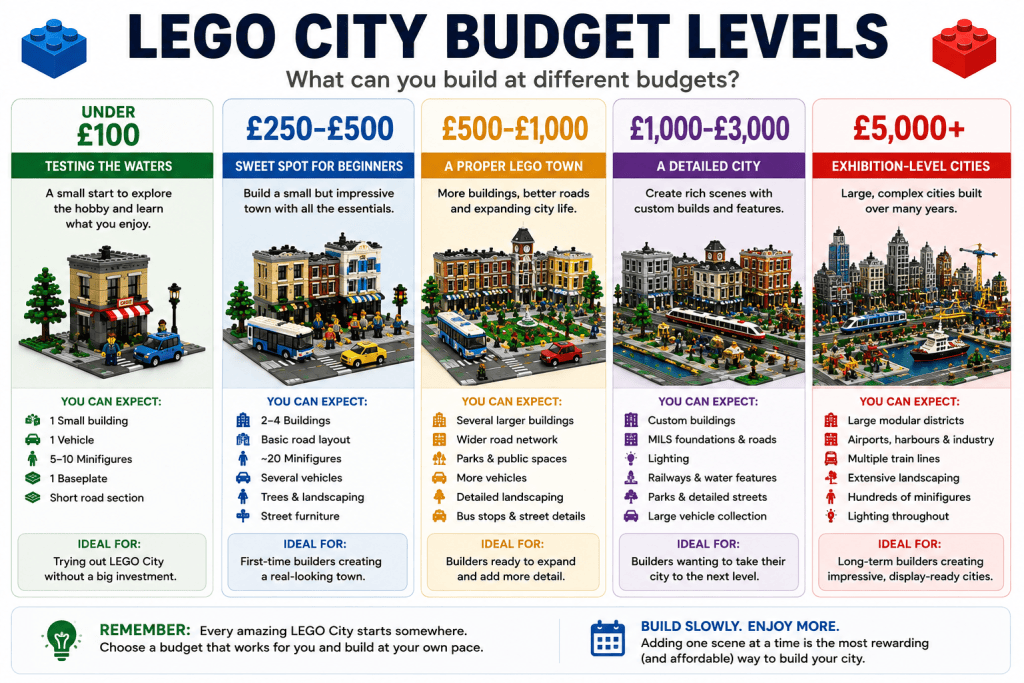
Under £100 — Testing the Waters
Perfect if you’re not yet sure whether building a LEGO City is the right hobby.
A typical budget could include:
- One small building
- One vehicle
- A few minifigures
- One baseplate
- A small road section
You’ll end up with a display rather than a city, but you’ll learn what styles of building and play you enjoy before investing more.
£250–£500 — The Sweet Spot for Beginners
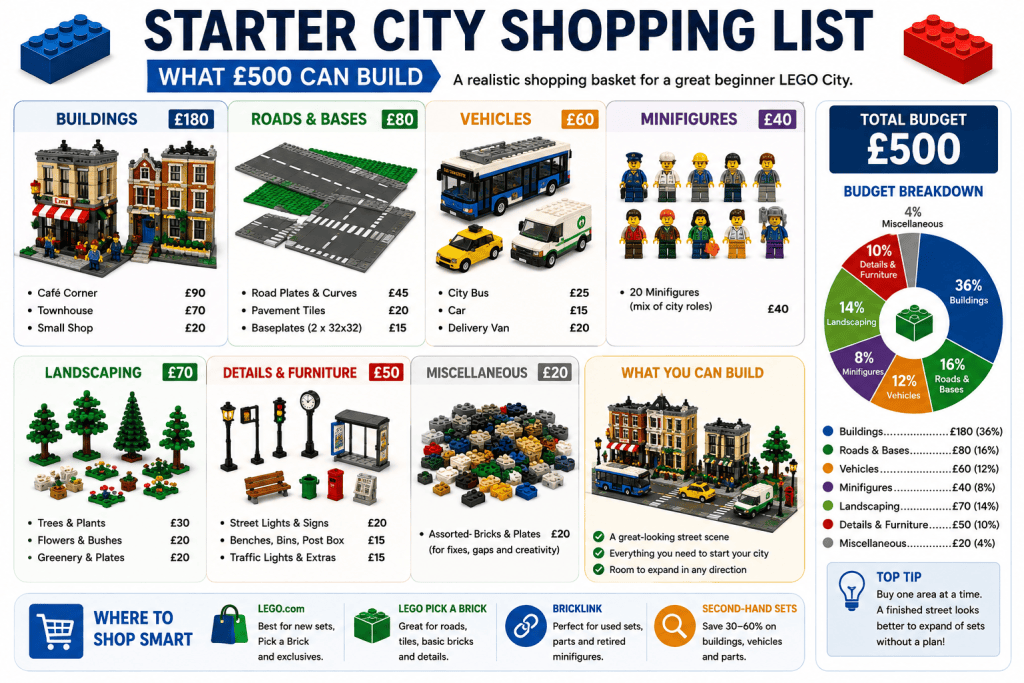
This is where we recommend most people begin.
A realistic shopping list might include:
- 2–4 buildings
- Basic road layout
- Around 20 minifigures
- Several vehicles
- Trees and landscaping
- Street furniture
By this point your layout starts looking like a real town rather than a collection of unrelated sets.
This is the budget we recommend for most new builders.
£500–£1,000 — A Proper LEGO Town
At this stage you have enough pieces to begin thinking about layout rather than simply adding sets.
You might include:
- Several larger buildings
- Wider road network
- Public spaces
- Parks
- Bus stops
- More detailed landscaping
- Larger collection of vehicles
Visitors will immediately recognise it as a functioning town.
£1,000–£3,000 — A Detailed City
Now creativity becomes more important than spending.
Many builders start adding:
- Custom buildings
- Brick-built roads
- MILS foundations
- Lighting
- Railways
- Rivers
- Waterfronts
- Larger parks
- Detailed streets
At this stage you’re creating scenes rather than simply displaying sets.
£5,000+ — Exhibition-Level Cities
Cities at this level have usually been built over many years, not in one shopping trip.
Typical features include:
- Large modular districts
- Airports
- Industrial areas
- Harbours
- Multiple train lines
- Extensive landscaping
- Hundreds of minifigures
- Lighting throughout
- Custom-built landmarks
Many exhibition cities represent 10–20 years of collecting rather than a huge one-off investment.
Where Does the Money Go?
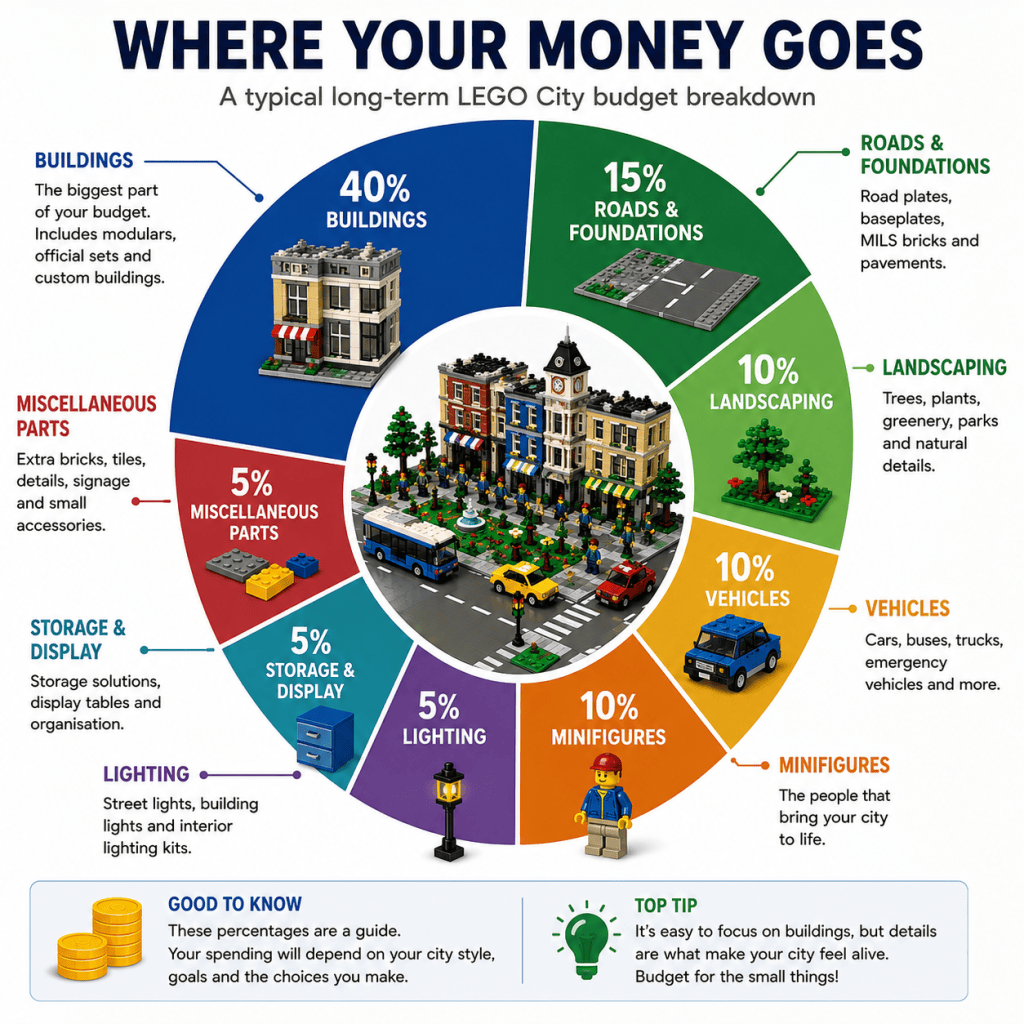
Many beginners assume most of the budget goes on buildings.
Buildings are certainly the largest expense, but they’re only part of the picture.
A typical long-term budget often looks something like this:
| Category | Approximate Spend |
| Buildings | 40% |
| Roads & foundations | 15% |
| Landscaping | 10% |
| Vehicles | 10% |
| Minifigures | 10% |
| Lighting | 5% |
| Storage & display | 5% |
| Miscellaneous parts | 5% |
One of the biggest surprises for new builders is how quickly the “small things” add up. Trees, street lamps, benches, traffic lights and extra bricks don’t cost much individually, but together they make a huge difference to how realistic your city feels.
Before You Buy
Before spending hundreds of pounds, ask yourself three simple questions:
How much space do I actually have?
A £1,000 city isn’t much fun if it has nowhere permanent to live.
Measure your available display space before buying more buildings.
Do I want to collect sets or build my own city?
Some people enjoy collecting official sets.
Others prefer creating custom streets and buildings.
Knowing which type of builder you are will help you spend your money far more effectively.
Am I happy building over several years?
The vast majority of impressive LEGO cities weren’t built in a weekend.
Growing slowly is perfectly normal.
[BR²] Brick Squared Tip
Treat your LEGO City like a long-term project rather than a shopping list.
Buying one excellent building every couple of months is usually far more satisfying than buying several random sets in a single weekend.
Where Can You Save Money?
Building a great city doesn’t necessarily mean spending more.
Some of the best-looking layouts use smart buying strategies rather than huge budgets.
Buy Used LEGO
Buying second-hand sets or loose bricks can often reduce costs by 30–60%.
Always check:
- Missing pieces
- Yellowing
- Cracked elements
- Instructions
- Minifigures
Mix Different LEGO Themes
Not every building needs to be an expensive Modular Building.
Many excellent cities combine:
- LEGO City
- LEGO Creator
- LEGO Friends
- Brick-built MOCs
- Older retired sets
The mix often makes the finished city look more realistic.
Buy Individual Parts
If you only need windows, trees or road tiles, buying individual pieces is often cheaper than purchasing an entire set.
Useful sources include:
- LEGO Pick a Brick
- BrickLink
Build One Area at a Time
Instead of buying ten unrelated buildings, complete one street before moving on.
Finished areas feel far more rewarding than lots of half-finished projects.
Budget Builder
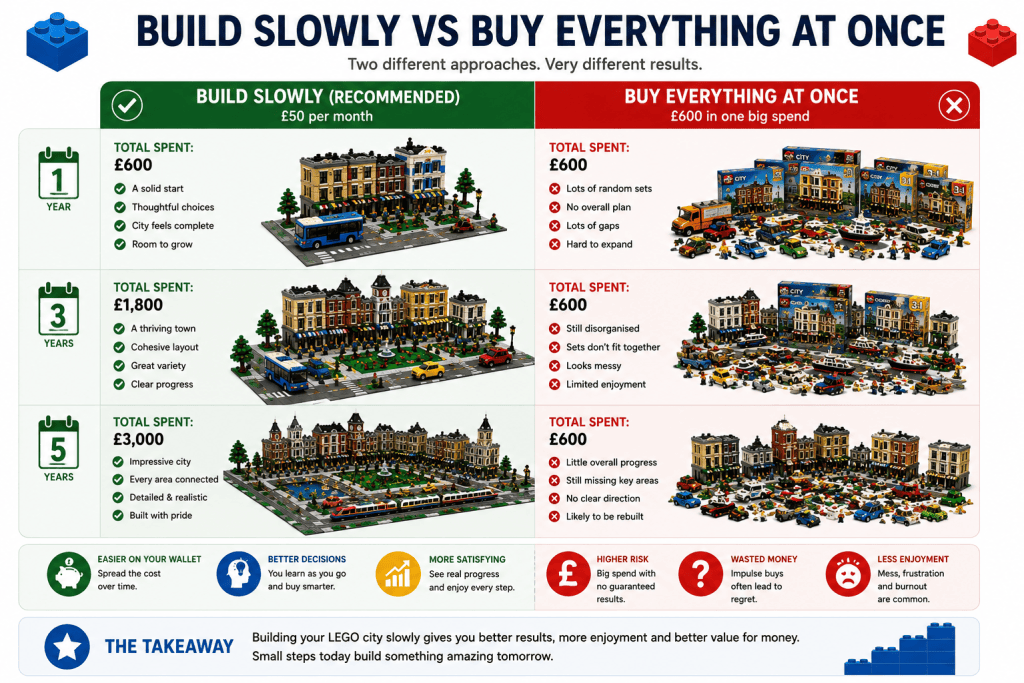
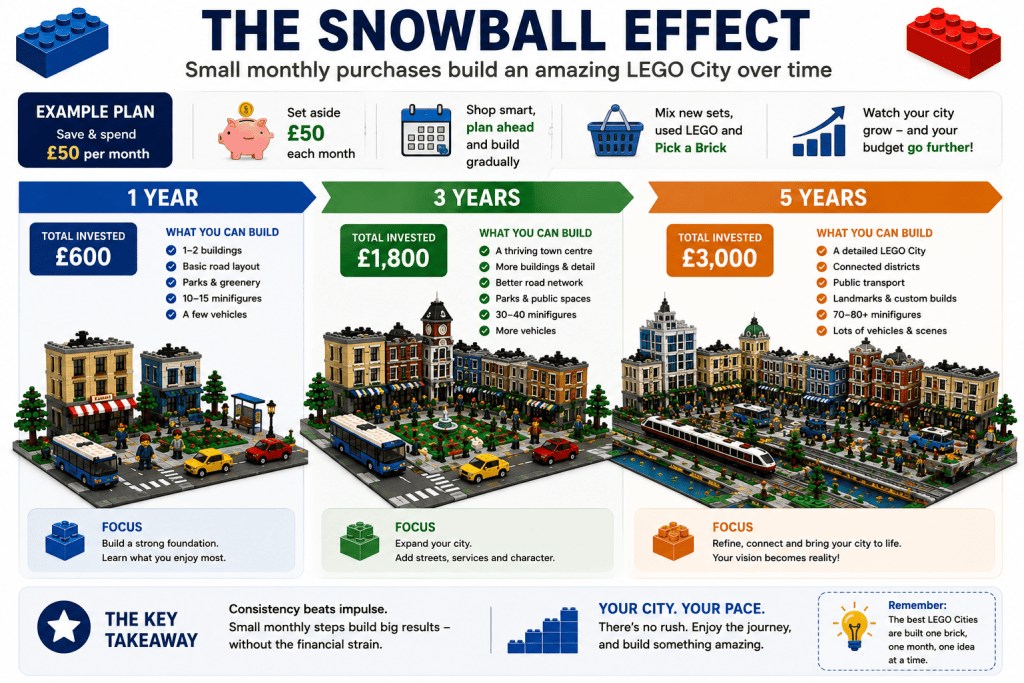
Suppose you set aside £50 per month.
After:
- 1 year: around £600 invested
- 3 years: around £1,800 invested
- 5 years: around £3,000 invested
Without ever making a huge purchase, you’ll have built a substantial city while spreading the cost comfortably.
This gradual approach also gives you time to learn what works and avoid expensive mistakes.
Should You Buy New or Used LEGO?
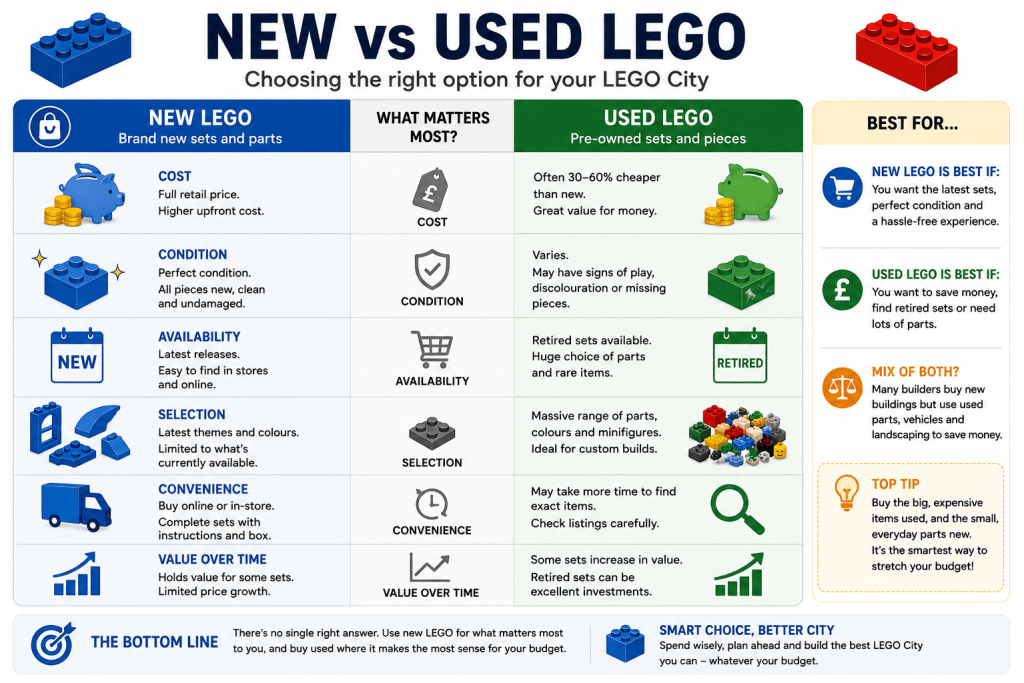
Most experienced builders eventually use both.
| New LEGO | Used LEGO |
| Perfect condition | Lower prices |
| Easy to buy | Excellent value |
| Latest releases | Retired sets available |
| Complete and sealed | Larger choice of parts |
| Higher upfront cost | Requires careful checking |
There isn’t a single right answer.
Many builders buy new buildings but source used bricks, vehicles and landscaping pieces to stretch their budget further.
Inspiration
Some of the most impressive LEGO Cities online weren’t built because someone had a huge budget.
They were built because someone added one new scene every month.
A café.
A bus stop.
A small park.
A row of houses.
Over time those small additions become an entire city.
Consistency nearly always beats spending.
Common Mistake
Trying to buy everything at once.
Beginners often purchase several sets they love before deciding where roads, pavements and public spaces will go.
The result is usually:
- No overall layout
- Buildings that don’t fit together
- Little room for expansion
- Expensive rebuilding later
Planning first nearly always saves money.
Required Parts & Tools
You don’t need specialist equipment to get started, but these can make building easier:
- Baseplates or MILS foundations
- Brick separator
- Storage boxes or drawer organisers
- Measuring tape (for planning your display space)
- Notebook or digital planning app
- LEGO Pick a Brick wishlist
- BrickLink wanted list
Resources
These products genuinely provide value for beginners:
- LEGO Pick a Brick – Ideal for buying roads, trees, windows and common elements without purchasing whole sets.
- BrickLink – Excellent for retired sets, individual pieces and minifigures.
- Stackable storage drawers – Keep spare parts organised as your collection grows.
- Brick separator – An inexpensive tool that quickly pays for itself.
- LED lighting kits (once your layout is established) – Add realism without rebuilding.
- LEGO building idea books – Useful once you’re ready to design custom buildings rather than relying entirely on official sets.
Key Takeaways
- A LEGO City can cost anywhere from under £100 to well over £5,000.
- £250–£500 is a realistic starting budget for most beginners.
- Buildings are only part of the overall cost—roads, landscaping and details add up too.
- Buying used LEGO and individual parts can save significant money.
- Building one section at a time usually creates a better city than buying everything at once.
- The best LEGO Cities are built gradually over many months or years.
[BR²] Brick Squared Verdict
The cost of a LEGO City is entirely up to you.
Don’t compare your beginning with someone else’s finished city.
Start with a realistic budget, build one area well, and expand at your own pace.
A carefully planned £500 city will almost always look better than a rushed £2,000 collection of unrelated sets.
Building slowly isn’t settling for less—it’s how many of the world’s best LEGO Cities were created.
Read Next
Continue building your LEGO City with these beginner guides:
What Is a LEGO City? A Beginner’s Guide (Article 1)
How Much Space Do You Need for a LEGO City? (Article 3)
How to Build a LEGO City on a Budget (Article 4)
Where Should You Start Your LEGO City? (Article 5)
How to Plan a LEGO City Before You Build It (Article 6)
How to Make LEGO Roads Cheaper (Article 16)